
Why Platform Consolidation Is Driving ServiceNow Adoption
Om
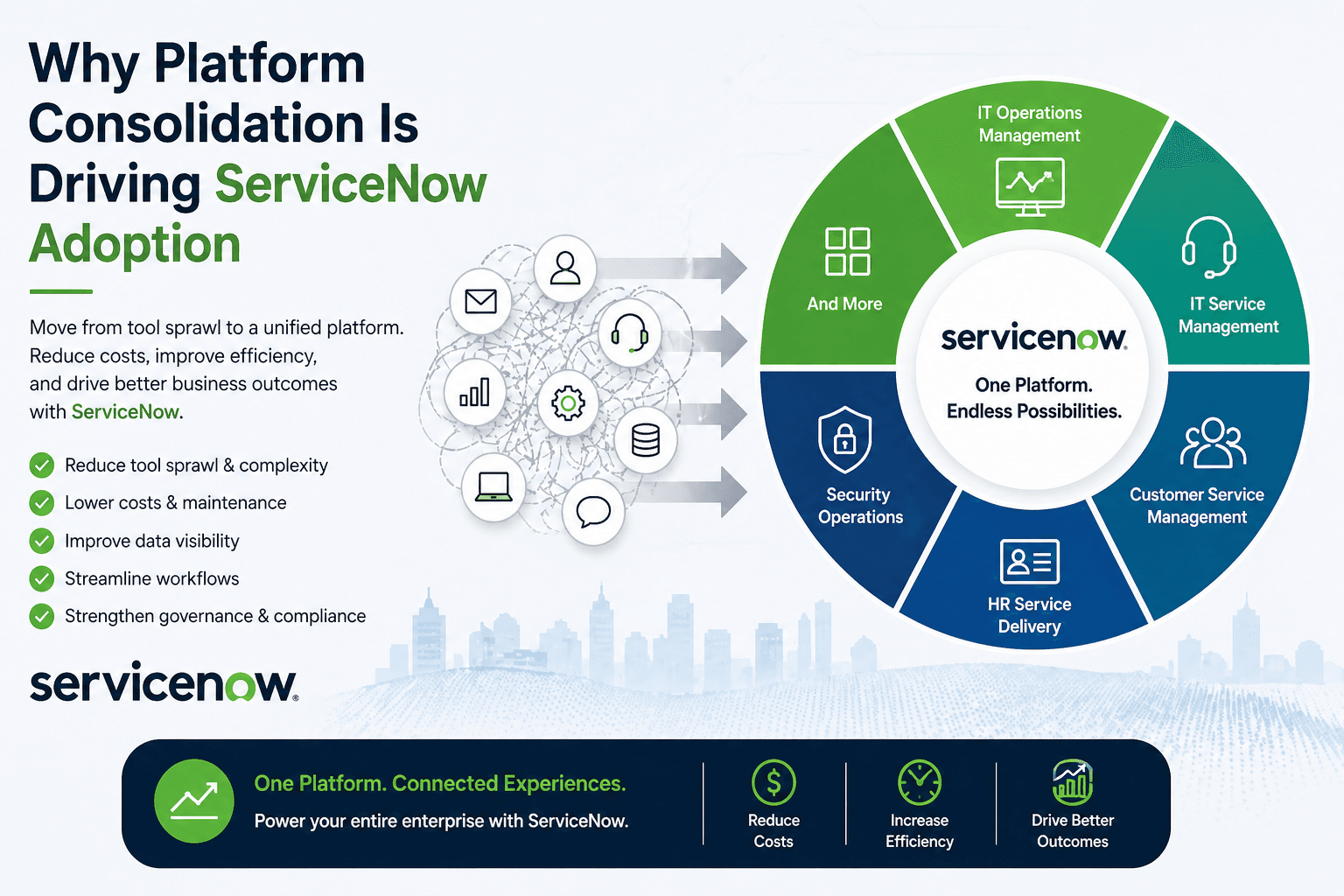
Learn why platform consolidation is a key driver behind ServiceNow adoption and how organizations are reducing costs, improving efficiency, and simplifying operations.
The Growing Problem of Tool Sprawl
Over the years, many organizations have adopted multiple tools to manage different functions:
IT service management
Monitoring and operations
Customer support
HR processes
Security operation
While each tool solves a specific problem, together they often create complex, disconnected ecosystems.
This challenge—commonly known as tool sprawl—is becoming a major barrier to efficiency.
What Is Platform Consolidation?
Platform consolidation is the strategy of reducing multiple tools and replacing them with a single, unified platform that can handle multiple business functions.
Instead of managing 8–10 different systems, organizations aim to centralize operations on platforms like ServiceNow.
Why Organizations Are Moving Toward Consolidation
1. Reducing Operational Complexity
Managing multiple tools means dealing with:
Different interfaces
Multiple vendors
Complex integrations
Fragmented workflows
A unified platform simplifies operations significantly.
2. Lowering Costs
Multiple tools lead to:
Licensing costs
Integration expenses
Maintenance overhead
Training requirements
Consolidation helps organizations optimize costs by reducing redundancy.
3. Improving Data Visibility
When systems are disconnected, data is siloed.
With a centralized platform:
Data is unified
Reporting becomes more accurate
Decision-making improves
4. Enhancing Workflow Efficiency
Disconnected tools create delays and manual handoffs.
With ServiceNow:
Workflows are integrated end-to-end
Automation spans across departments
Processes become faster and more reliable
5. Strengthening Governance and Control
Managing compliance and governance across multiple tools is challenging.
A single platform enables:
Better control over processes
Standardized workflows
Easier compliance management
Why ServiceNow Is a Key Enabler
ServiceNow is uniquely positioned to support platform consolidation because of:
Its modular architecture
Unified data model
Cross-functional capabilities
Strong integration ecosystem
Scalability across departments
Organizations can start with one use case and gradually consolidate more functions onto the platform.
Real-World Example of Consolidation
A typical organization might have:
One tool for ITSM
Another for monitoring
A separate CRM for customer support
HR tools for employee services
By consolidating onto ServiceNow, they can:
Reduce the number of platforms
Integrate workflows seamlessly
Improve service delivery across all departments
Challenges to Consider
Platform consolidation is powerful—but not without challenges:
Migration complexity
Data integration and cleanup
Change management
User adoption
Need for experienced implementation partners
Organizations need a clear strategy to ensure a successful transition.
What This Means for Business Leaders
Platform consolidation is no longer just an IT initiative—it’s a business strategy.
Leaders are focusing on:
Operational efficiency
Cost optimization
Better customer and employee experiences
Scalable digital transformation
And consolidation plays a key role in achieving these goals.
Final Thoughts
As organizations grow, managing multiple disconnected tools becomes unsustainable.
Platform consolidation, powered by ServiceNow, offers a smarter way to simplify operations, reduce costs, and improve efficiency.
The organizations that move early will gain a significant advantage in agility and scalability.
Is your organization dealing with tool sprawl?
Pioneer Tech Solution helps businesses assess, consolidate, and optimize their platforms for long-term success