
The Rise of Low-Code/No-Code in the ServiceNow Ecosystem


Explore how low-code and no-code development in ServiceNow is transforming enterprise application development and accelerating digital transformation.
🚀 Introduction
Businesses today are under constant pressure to deliver solutions faster—without increasing development costs.
Traditional development approaches often create bottlenecks due to:
Long development cycles Dependency on developers Complex coding requirements
This is why low-code and no-code development is rapidly gaining traction within the ServiceNow ecosystem.
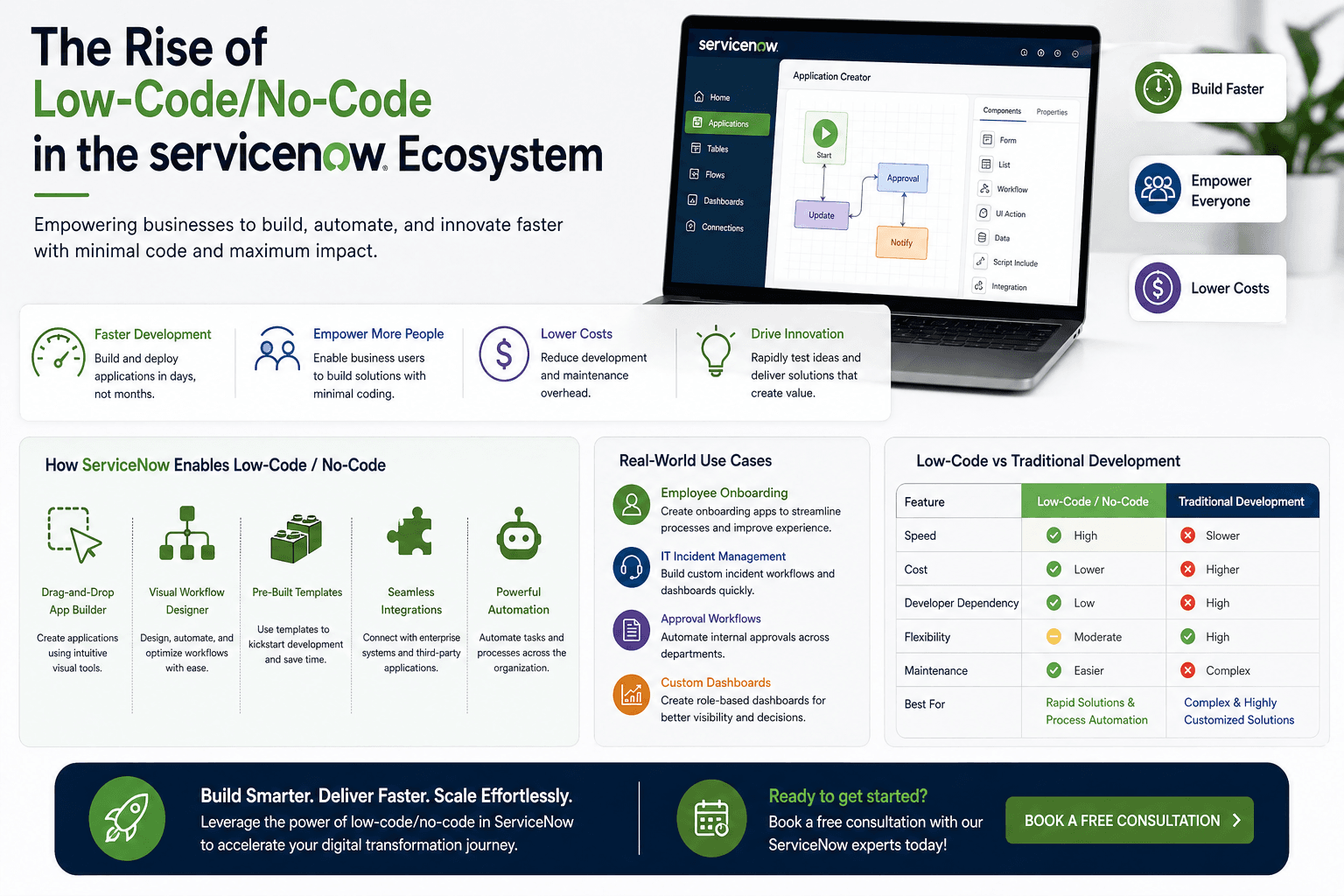
💡 What Is Low-Code / No-Code?
Low-code and no-code platforms allow users to build applications with minimal or no traditional coding.
Instead of writing complex code, users can:
Drag and drop components
Configure workflows visually
Automate processes using logic builders
👉 This makes development faster, more accessible, and scalable.
🔥 Why This Trend Is Growing Fast
Faster Time to Market
Organizations can build and deploy applications in days or weeks instead of months.
👉 Speed is now a competitive advantage.
Reduced Dependency on Developers
Business users and analysts can build solutions without relying entirely on engineering teams.
👉 This frees up developers for more complex tasks.
Cost Efficiency
Less development effort means:
Lower costs
Faster ROI
Reduced maintenance overhead
Increased Innovation
More people in the organization can contribute to building solutions.
👉 Ideas can be tested and deployed quickly.
🧠 How ServiceNow Enables Low-Code Development
ServiceNow provides powerful low-code capabilities through its platform.
Key features include:
Visual workflow designer
Drag-and-drop app builder
Pre-built templates Integration capabilities
Automation tools
👉 Organizations can rapidly build enterprise-grade applications.
🏢 Real-World Use Cases
Businesses are using low-code in ServiceNow to:
Automate internal approval processes
Build custom service portals
Create employee onboarding apps
Develop incident tracking dashboards
Integrate multiple systems
👉 These solutions can be built quickly and scaled easily.
⚖️ Low-Code vs Traditional Development
| Feature | Low-Code / No-Code | Traditional Development |
| Speed | High | Slower |
| Cost | Lower | Higher |
| Flexibility | Medium | High |
| Complexity Handling | Medium | Advanced |
| Developer Dependency | Low | High |
👉 The best approach is often a combination of both.
⚠️ Challenges to Consider
While low-code is powerful, it’s not a silver bullet.
Organizations should consider:
Governance and control
Platform limitations
Scalability planning
Security standards
Proper architecture design
👉 Without proper planning, low-code can lead to uncontrolled app sprawl.
🎯 Business Impact
Organizations adopting low-code in ServiceNow are seeing:
✔ Faster application delivery
✔ Improved agility
✔ Lower development costs
✔ Better alignment between IT and business teams
✔ Increased innovation
🔮 The Future of Development
Low-code and no-code are not replacing developers—they are changing how development works.
Future trends include:
Citizen developers
AI-assisted app building
Faster automation cycles
Cross-functional collaboration
👉 This is a major shift in enterprise technology strategy.
🔵 Call to Action (CTA)
Looking to build applications faster without heavy development?
👉 Pioneer Tech Solution helps you leverage low-code capabilities in ServiceNow to:
Build custom applications
Automate workflows
Reduce development time
Scale efficiently
👉 Book a free consultation today: +1 443 360-7642 Ext 800 or email [email protected]