
ServiceNow Modules Explained: ITSM, ITOM, CSM & More


Explore key ServiceNow modules including ITSM, ITOM, CSM, HRSD, and SecOps. Learn how each module helps businesses streamline workflows and improve efficiency.
Understanding the ServiceNow Platform
One of the biggest strengths of ServiceNow is its modular architecture.
Organizations don’t need to implement everything at once. They can start with a single module—often ITSM—and expand into other areas as their digital transformation matures.
But what exactly do these modules do?
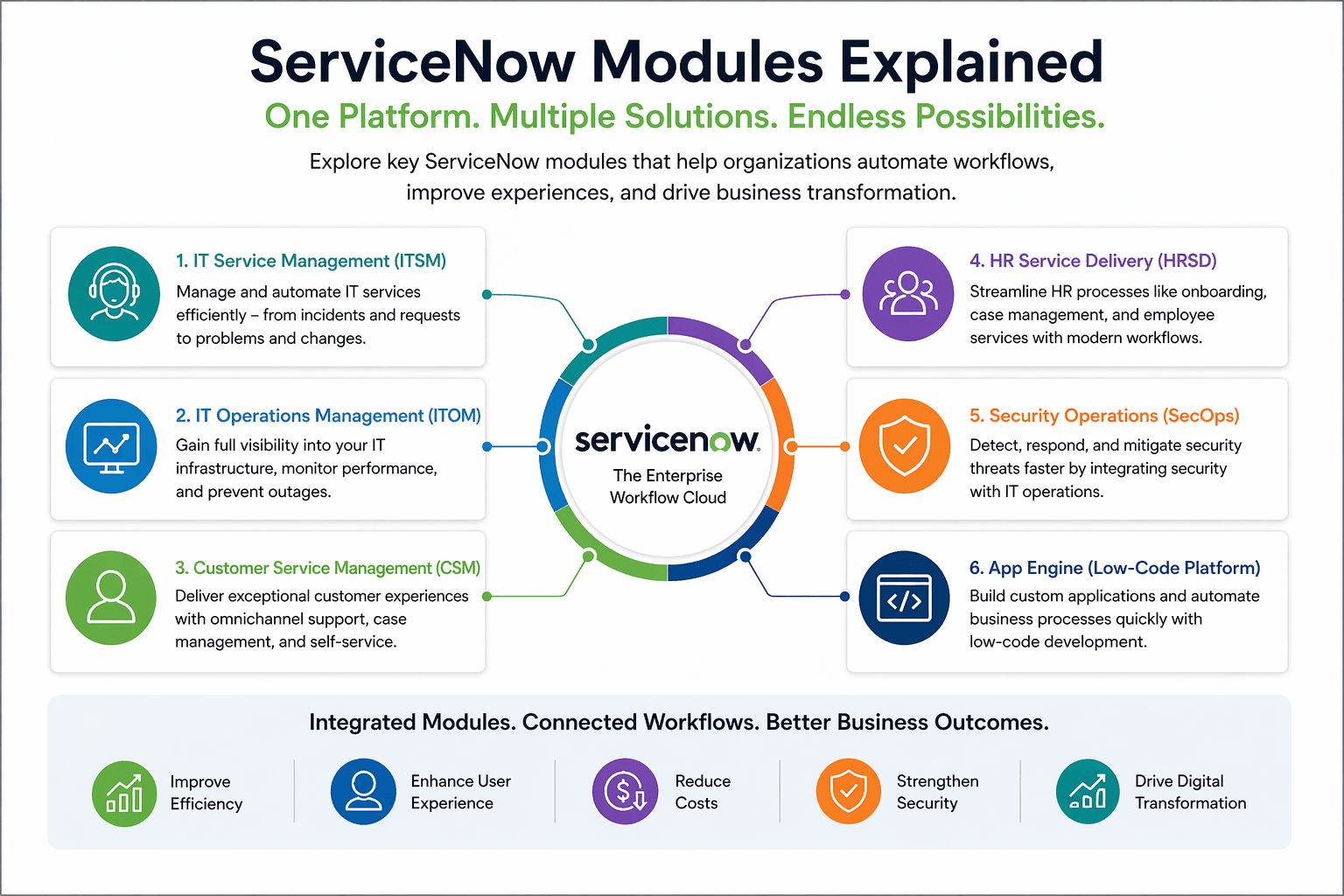
1. IT Service Management (ITSM)
ITSM is the foundation of most ServiceNow implementations.
It focuses on managing IT services efficiently through:
Incident management (resolving issues)
Request management (handling service requests)
Problem management (identifying root causes)
Change management (controlling system changes)
Business Value:
Improves service delivery, reduces downtime, and enhances user satisfaction.
2. IT Operations Management (ITOM)
ITOM provides visibility into your IT infrastructure and operations.
It includes:
Discovery of IT assets
Service mapping
Event management
Cloud and infrastructure monitoring
Business Value:
Helps prevent outages, improves system reliability, and enables proactive operations.
3. Customer Service Management (CSM)
CSM is designed to improve customer support and service experiences.
It enables:
Case management
Omnichannel support
Self-service portals
Knowledge management
Business Value:
Faster resolution times and improved customer satisfaction.
4. HR Service Delivery (HRSD)
HRSD transforms traditional HR processes into efficient digital workflows.
It supports:
Employee onboarding
Case management for HR queries
Document management
Employee self-service
Business Value:
Improves employee experience and reduces HR workload.
5. Security Operations (SecOps)
SecOps integrates security with IT operations to respond to threats faster.
It includes:
Security incident response
Vulnerability management
Threat intelligence integration
Business Value:
Enhances security posture and reduces risk exposure.
6. App Engine (Low-Code Platform)
ServiceNow also provides a low-code platform to build custom applications.
Organizations can:
Create custom workflows
Automate business processes
Build internal tools without heavy coding
Business Value:
Faster development and reduced dependency on traditional development cycles.
Choosing the Right Module: Where Should You Start?
Many organizations struggle with this question.
The answer depends on your business priorities:
Start with ITSM if your IT processes need structure
Expand to ITOM for infrastructure visibility
Adopt CSM to improve customer experience
Use HRSD for internal employee services
Implement SecOps for security-driven organizations
The key is to align module adoption with business goals—not just technology trends.
The Real Power: Integration Across Modules
While each module delivers value individually, the real strength of ServiceNow lies in integration.
For example:
IT incidents can trigger security workflows
HR onboarding can automatically provision IT access
Customer issues can link to backend IT problems
This interconnected ecosystem creates end-to-end workflow automation across the enterprise.
Final Thoughts
ServiceNow modules are not just features—they are building blocks for enterprise transformation.
Organizations that strategically adopt and integrate these modules can achieve:
Better operational efficiency
Improved service experiences
Stronger scalability
Reduced operational complexity
Not sure which modules are right for your organization?
Pioneer Tech Solution helps businesses assess, implement, and scale the right ServiceNow solutions based on their needs.